

Land Challenges for Farmers: How Precise Boundary Mapping Helps Prevent Conflicts and Reduce Costs
23.01.2026
- Common land-related challenges faced by farmers
- 1. Boundary disputes between land parcels
- 2. High cost of surveying services
- Why basic GPS is no longer sufficient
- GNSS RTK — a technology that has become accessible
- What has changed in recent years
- Why this matters specifically for farmers
- Geometer Y55G — a practical solution for land management
- Key advantages
- Software
- When a standalone GNSS RTK receiver is the better choice
- Situations where a standalone GNSS RTK receiver is preferable
- How to choose the right tool
For farmers, land is not just a resource — it is the foundation of the business. At the same time, land-related issues create some of the most frequent and costly challenges in everyday operations: disputes with neighbors, fragmented parcels, inaccurate area calculations, record-keeping errors, and direct financial losses.
Agricultural enterprises constantly bring new land into production — individual land shares and plots — sign lease agreements, and restructure field layouts. In every one of these processes, it is critically important to know the exact boundaries of the land that is actually being cultivated.

Common land-related challenges faced by farmers
1. Boundary disputes between land parcels
The most common situation involves disputes with neighboring farmers or landowners over parcel boundaries. This is especially relevant when:
- not all land shares within a field are leased;
- a so-called “checkerboard” structure appears, making it impossible to cultivate the entire field as one unit;
- boundaries shown in documents do not match actual field operations.
In such cases, agricultural enterprises are often forced to hire surveyors to physically mark parcel boundaries in the field.
2. High cost of surveying services
Even a single surveyor visit usually includes:
- a call-out or travel fee;
- payment for each measured point.
When these situations occur multiple times throughout the year, costs can easily grow into tens of thousands of hryvnias. This is why many agricultural enterprises establish their own land management departments, staffed by a land clerk or land survey specialist responsible for:
- area accounting;
- boundary control;
- lease term monitoring;
- communication with landowners.
Why basic GPS is no longer sufficient
Knowing the approximate size of a field is important — but in modern agriculture, it is no longer enough. Farmers increasingly work with:
- official cadastral data;
- ownership verification;
- land use designation;
- official parcel coordinates.
To work correctly with such data, the following tools are required:
GNSS RTK — a technology that has become accessible
Just a few years ago, GNSS RTK technology was associated almost exclusively with large agricultural holdings, engineering companies, and professional surveyors. High equipment costs, complex configuration, and the need for specialized training made it inaccessible to most farming operations. Over the past few years, however, the situation has changed dramatically.
GNSS RTK has become compact, intuitive, and genuinely practical for everyday agricultural use. Today, a farmer does not need to be a surveyor to work with centimeter-level accuracy — modern solutions are designed specifically for field conditions and real-world tasks.
What has changed in recent years
GNSS RTK technology has become simpler and more accessible due to several key developments:
- Compact hardware. Modern RTK devices no longer require bulky antennas or complex installations. Many solutions look and operate like standard mobile devices.
- User-friendly software. Interfaces are intuitive, and key operations — boundary staking, area measurement, point control — can be performed in just a few steps.
- Centimeter-level accuracy in the field. RTK corrections provide precision sufficient for working with official cadastral boundaries, not just approximate map outlines.
- Minimal training requirements. Today’s solutions are designed for agronomists, land managers, and land clerks — not only professional surveyors.
- Real economic benefits. Owning RTK equipment reduces dependence on external surveying services and allows faster responses to land-related issues.
Why this matters specifically for farmers
In agriculture, GNSS RTK is no longer a niche or experimental technology. It has become a practical tool for:
- accounting for land that is actually being cultivated;
- verifying parcel boundaries without calling in surveyors;
- controlling field areas before planting and after harvest;
- resolving disputes with landowners and neighboring farms;
- reducing financial and legal risks.
GNSS RTK gives farmers something far more valuable than numbers on a map — real control over their land. This control becomes especially important for large operations, where cultivated areas consist of hundreds of individual parcels and field structures change constantly. In such conditions, even small inaccuracies can quickly turn into financial losses or conflicts.
A good example is a large farming operation managing more than 11,000 hectares of land. Its fields consist of hundreds of individual land parcels, some of which regularly change tenants, requiring continuous boundary control and verification.
Previously, the farm:
- called in surveyors several times a year;
- paid for boundary staking and area verification;
- lost valuable time during planting and harvest seasons.
After purchasing the Geometer Y55G, the situation changed significantly:
- the land clerk independently stakes parcel boundaries in the field;
- verifies cadastral coordinates with approximately 2.5 cm accuracy;
- controls actual field operations;
- responds quickly to disputes and boundary issues.
Within the first year, the device fully paid for itself — external surveying costs were reduced several times over, and area accounting errors were eliminated.
“Yes, we invested in the equipment. But now we are no longer dependent on someone else’s schedule and we don’t pay for every single point. We control our land ourselves,” says the farm manager.

Geometer Y55G — a practical solution for land management
Today, the Geometer Y55G is one of the most convenient tools for:
- farmers;
- agronomists;
- land management departments.
Key advantages
- built-in GNSS RTK module;
- bright 5.5″ display;
- rugged “industrial smartphone” form factor;
- centimeter-level accuracy with RTK corrections;
- PPP mode with ~20 cm accuracy without paid corrections (Galileo HAS).
Software
- Geometer SCOUT — for basic tasks such as field area measurement and agronomic zone definition;
- SurPad 4.2 — professional surveying software for cadastral data, coordinates, and project work.
When a standalone GNSS RTK receiver is the better choice
Despite the fact that modern handheld solutions have greatly simplified working with coordinates, there are scenarios where a classic standalone GNSS RTK receiver with a pole-mounted antenna is the better option. This is especially true for agricultural enterprises that employ experienced surveyors or land engineers performing complex measurements on a regular basis.
In such cases, not only accuracy matters, but also the physical capabilities of the equipment — antenna height, signal stability in challenging environments, and compliance with traditional surveying standards. A standalone RTK receiver offers greater flexibility when working with difficult terrain, elevation changes, and hard-to-reach points, where handheld devices may be physically limited.
Situations where a standalone GNSS RTK receiver is preferable
- Challenging signal conditions. Work near forest belts, buildings, power lines, or uneven terrain requires stable satellite reception.
- Need to raise the antenna higher. Pole-mounted antennas allow the receiver to be raised several meters, which is impossible with handheld devices limited by the operator’s height.
- Classical surveying tasks. Control points, boundary monumentation, and verification measurements requiring strict compliance with surveying standards.
- Intensive daily use. For constant, high-volume measurement work, standalone receivers with external antennas are often more durable.
How to choose the right tool
Geometer Y55G is a highly convenient, mobile, and practical solution for most agricultural land tasks — from accounting for cultivated land to boundary verification and area control. At the same time, it is not designed to replace every professional surveying scenario.
The rule is simple: the tool must match the task.
- For land accounting, parcel control, and fast field work — Geometer Y55G.
- For complex surveying and professional measurements — a standalone GNSS RTK receiver.
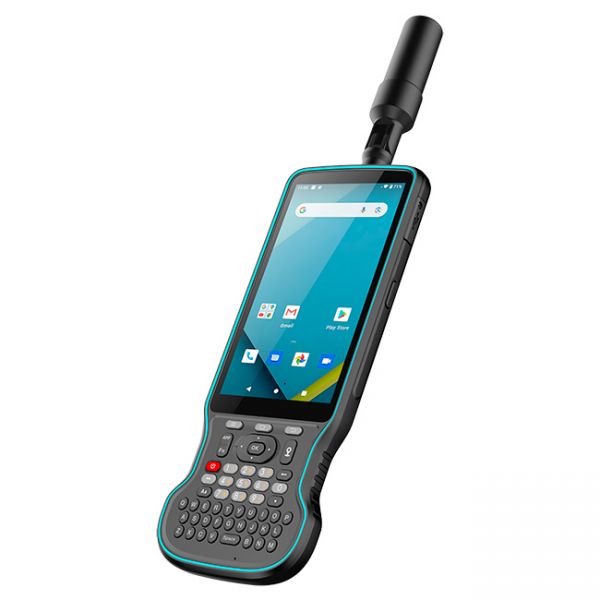
The Y55G field controller is a modern geodetic controller with an integrated GNSS RTK receiver. It features a multi-frequency 1408-channel board supporting L1, L2, and L5 bands. The device supports all major satellite systems: GPS, GLONASS, BeiDou, Galileo, QZSS, and IRNSS, ensuring stable positioning even in challenging environments.
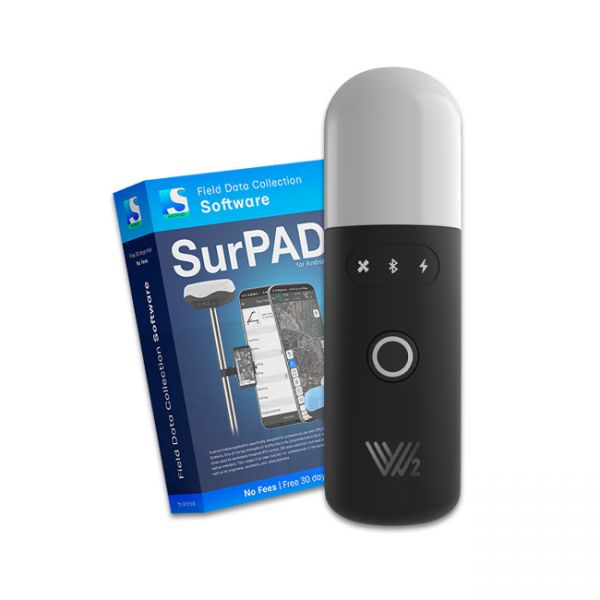
The Walker 2 receiver is an exceptionally lightweight and compact GNSS RTK device, weighing only 220 grams, designed for convenient use in any field conditions. Its sealed and shock-resistant housing withstands drops from heights up to 1.6 meters, ensuring reliability on construction sites, in agriculture, and in challenging terrain.
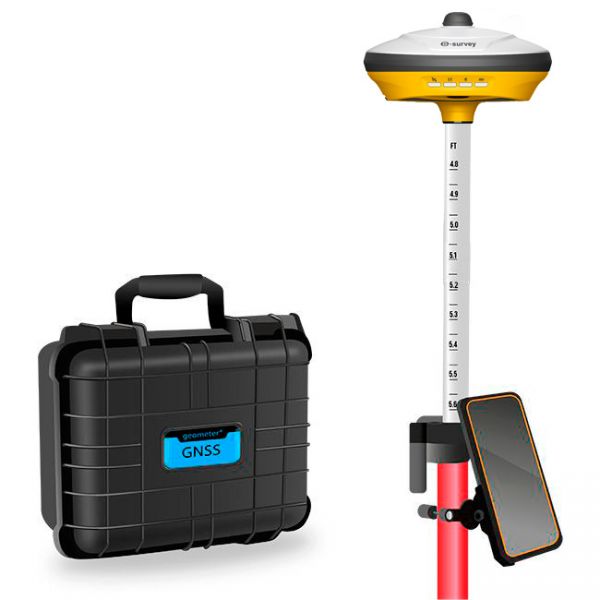
Multifrequency Geodetic GNSS RTK e200 KIT is a high-performance network receiver designed to exceed your productivity expectations. This entry-level GNSS solution supports multiple frequencies from various satellite constellations, ensuring enhanced positioning accuracy.